Critically acclaimed by some when it first aired and now
considered a cult classic of the western television drama, The Westerner owes its lofty reputation to being an early work of
controversial and revered director Sam Peckinpah. Peckinpah's knowledge of the
wild west was secondhand but perhaps more real than all the other directors and
producers who churned out cookie-cutter horse operas in the late 1950s and
early 1960s. He had grown up near Fresno, California where his grandfather ran
a ranch that not only allowed the young Peckinpah to experience ranch life
first hand but to also hear the stories of descendants of 19th century miners
and ranchers who worked on his grandfather's spread. After a stint in the
Marines in which he served in the Pacific and witnessed firsthand the brutality
of war between the Chinese and Japanese, he enrolled at California State
University, initially studying history until his first wife Marie Selland got
him interested in theater and directing. He went on to earn a master's degree
from USC, worked as a stage hand on local TV, and worked for director Don
Siegel as a dialogue coach on several of his films. With Siegel's
recommendation he began getting scriptwriting assignments for western TV series
such as Gunsmoke, Have Gun -- Will Travel, and Broken Arrow. His script for an episode
of Dick Powell's Zane Grey Theatre
became the basis for the series The Rifleman, for which Peckinpah directed four episodes and wrote several
others. His association with Powell's anthology series eventually led to The Westerner as his 1959 episode
"Trouble at Tres Cruces" became the unofficial pilot for the 1960
series. The pilot revolved around a high-powered Winchester repeating rifle
which is bequeathed to drifter Dave Blassingame (played by Brian Keith) and
which he uses to exact revenge on the killer of the rifle's original owner.
Initially the series was to be called The
Winchester and focus strongly on the high-powered gun, much like Lucas
McCain's trademark gun in The Rifleman.
 While the Winchester does figure prominently in The Westerner's first episode
"Jeff" (September 30, 1960) and "The Old Man" (November 25,
1960), it is not central to the theme of these two episodes and is rarely seen
in the other 11 episodes. But the violence and brutality that earned Peckinpah
the nickname "Bloody Sam" is very much a part of the series, though
the intensity of the violent episodes is leavened by the series' three comic
episodes--"Brown" (October 21, 1960), "The Courting of Libby"
(November 11, 1960), and "The Painting" (December 30, 1960)--all
three directed by Peckinpah and co-starring John Dehner as Blassingame's friend
and foil Burgundy Smith. As film historians Paul Seydor, Garner Simmons, David
Weddle, and Nick Redman note in their commentary for the 2017 DVD release, The Westerner is a case study in
Peckinpah's skill as a director and script writer even before he made his first
feature film and an exploration of his demythologizing of the old west. Though
he sometimes gets miscast as a promoter of graphic violence, these film
historians point out that in The
Westerner violence has real-world
and often tragic consequences, unlike almost all the other westerns from
the era.
While the Winchester does figure prominently in The Westerner's first episode
"Jeff" (September 30, 1960) and "The Old Man" (November 25,
1960), it is not central to the theme of these two episodes and is rarely seen
in the other 11 episodes. But the violence and brutality that earned Peckinpah
the nickname "Bloody Sam" is very much a part of the series, though
the intensity of the violent episodes is leavened by the series' three comic
episodes--"Brown" (October 21, 1960), "The Courting of Libby"
(November 11, 1960), and "The Painting" (December 30, 1960)--all
three directed by Peckinpah and co-starring John Dehner as Blassingame's friend
and foil Burgundy Smith. As film historians Paul Seydor, Garner Simmons, David
Weddle, and Nick Redman note in their commentary for the 2017 DVD release, The Westerner is a case study in
Peckinpah's skill as a director and script writer even before he made his first
feature film and an exploration of his demythologizing of the old west. Though
he sometimes gets miscast as a promoter of graphic violence, these film
historians point out that in The
Westerner violence has real-world
and often tragic consequences, unlike almost all the other westerns from
the era.
The standard formula for television westerns by 1960
centered around a mythic hero (sometimes a duo, as in Laramie and Lawman, or
ensemble, as in Wagon Train and Gunsmoke) who was either bound to a
place (again, Gunsmoke, Lawman, and The Rifleman) or wandered freely dispensing justice (Cheyenne and Have Gun -- Will Travel). In the single-location westerns, evil
typically comes from outside the community. In the picaresque-style westerns,
the hero encounters evil in the places he visits. In both cases, while the hero
can be occasionally wounded, he is invincible and the agent for defeating evil
or enabling the downtrodden to do so. Such a formula rarely allows for real
tragedy because the villains get what they deserve. Though occasionally a character
will begin as the embodiment of evil, we may learn that he is misguided and has
a change of heart, allowing him to be redeemed in this life, or if his sins
prove too severe, he is allowed to give his life to restore order and therefore
achieve redemption in the next life.
But this is not how the narratives generally play out in
Peckinpah's world, though "The Old Man" perhaps fits closest to the
standard redemption trope when dying patriarch Tyler McKeen willingly gives up
what short time remains for him to ensure that his estate passes to his
grandson rather than to the vulture-like distant relatives who show up and
demand that he bequeath his effects to them. McKeen even gives a dying speech
to his grandson that he would not have wanted to go out any other way. But in
the series opener "Jeff," Blassingame travels many miles to try to
rescue his childhood girlfriend currently trapped in an abusive and
exploitative relationship with a brutal former boxer named Denny Lipp. Though
Blassingame nearly convinces her to come away with him and endures a violent
shoot-out with Lipp's Indian bartender and a brawl with Lipp himself, Jeff
ultimately decides to stay in her sado-masochistic relationship with Lipp
because she cannot forgive herself for her descent into prostitution and she
believes that no one else can either. Blassingame as savior is foiled and is
forced to leave beaten and empty-handed. This is hardly the sort of "all's
right with the world" ending that pervaded 1960s westerns.
 While the film historians mentioned above consider the comic
episode "Brown" to be an extended depiction of the kind of drunken
bender that the notorious alcoholic Peckinpah himself experienced on many
occasions, he shows the other side of the coin in how drunkenness can lead to
pointless tragedy in "Line Camp" (December 9, 1960). In this episode
Blassingame runs across a traveling company of horse wranglers and lands a job
after finding one of their members dead along the trail. After joining them he
learns that the group also includes someone he has worked with before, Ben
Prescott, who is clearly an alcoholic and takes advantage of their foreman's
absence to break company rules in buying alcohol from some traveling hunters
and then getting drunk with the other wranglers, including Blassingame. But
when the foreman returns and fires Blassingame and Prescott for breaking the
rules, Blassingame accepts the decision and says he is guilty but he does not
want to travel with Prescott because he knows what kind of man he is from their
past acquaintance. This offends Prescott, still obviously intoxicated, who
begins spouting off that Blassingame intends to kill him once they both leave
camp, and even though Blassingame peacefully goes outside and tries to saddle
up to leave alone, Prescott follows him outside with his gun, begins firing at
him, and wounds him in the leg, forcing Blassingame to fire back and kill
Prescott. Blassingame reiterates that Prescott's behavior was senseless as he
posed no threat to him, and the foreman asks how he is going to explain to his
company how he wound up with one wrangler dead and another one incapacitated
due to his leg wound. There is no sense of justice at the end of this episode
because even though Prescott behaved foolishly and proved to be a threat to
Blassingame, he was not motivated by evil, only a paranoid obsession brought on
by too much alcohol. Here Peckinpah strips away the myth of good triumphing
over evil and shows the dire consequences of bad decisions, a much more
realistic depiction of human behavior than is found in all the other westerns
of the era.
While the film historians mentioned above consider the comic
episode "Brown" to be an extended depiction of the kind of drunken
bender that the notorious alcoholic Peckinpah himself experienced on many
occasions, he shows the other side of the coin in how drunkenness can lead to
pointless tragedy in "Line Camp" (December 9, 1960). In this episode
Blassingame runs across a traveling company of horse wranglers and lands a job
after finding one of their members dead along the trail. After joining them he
learns that the group also includes someone he has worked with before, Ben
Prescott, who is clearly an alcoholic and takes advantage of their foreman's
absence to break company rules in buying alcohol from some traveling hunters
and then getting drunk with the other wranglers, including Blassingame. But
when the foreman returns and fires Blassingame and Prescott for breaking the
rules, Blassingame accepts the decision and says he is guilty but he does not
want to travel with Prescott because he knows what kind of man he is from their
past acquaintance. This offends Prescott, still obviously intoxicated, who
begins spouting off that Blassingame intends to kill him once they both leave
camp, and even though Blassingame peacefully goes outside and tries to saddle
up to leave alone, Prescott follows him outside with his gun, begins firing at
him, and wounds him in the leg, forcing Blassingame to fire back and kill
Prescott. Blassingame reiterates that Prescott's behavior was senseless as he
posed no threat to him, and the foreman asks how he is going to explain to his
company how he wound up with one wrangler dead and another one incapacitated
due to his leg wound. There is no sense of justice at the end of this episode
because even though Prescott behaved foolishly and proved to be a threat to
Blassingame, he was not motivated by evil, only a paranoid obsession brought on
by too much alcohol. Here Peckinpah strips away the myth of good triumphing
over evil and shows the dire consequences of bad decisions, a much more
realistic depiction of human behavior than is found in all the other westerns
of the era.
The episode "Hand on the Gun" (December 23, 1960)
paints a similar picture of someone taking things too far and receiving more
than he bargained for. In this case, it is easterner Calvin Davis, who joins
Blassingame's group of wild horse wranglers thinking that because he has read
about the west and can do a few gun tricks that he can take on anyone. The
greenhorn who gets in over his head is common trope in television westerns, but
is usually played for comic effect. Peckinpah's version is grimmer because it
shows that gunplay is not a kid's game. Besides feeling like he has something
to prove, Davis also displays a racist streak in calling Blassingame's friend Oresquote
Solera a "pepper gut," an insult because of Solera's Mexican
heritage. After the group has delivered the horses they've captured and have
been paid, Davis wants to continue in Blassingame's employ, but the latter
doesn't want him because he has seen how reckless and hard-headed he is. Davis
tries to strike back by repeating his insult to Solera and will not be
satisfied with anything other than a showdown in the street. Earlier in the
episode Blassingame tries to each Davis the real-world consequences of a gun
wound by having Solera show him where a bullet entered his abdomen and then
exited from a much larger hole in his back, a wound that laid Solera up for 8
months recovering. But Davis fails to heed the warning, and when he faces
Solera in the street he gets off the first shot at point blank range but
misses. Solera doesn't miss in returning fire, and Davis drops to the street in
shock, still not believing that the duel didn't play out the way he imagined,
as Blassingame and Solera ride out of town, leaving him to die. Here another
life is wasted because someone failed to grasp the serious, tragic consequences
of the violence that a gun can deliver. Rather than being a champion of
bloodshed and violence, as he is often labeled, Peckinpah is unblinking and graphic
in his depiction of violence to show the viewer what can really happen in the
real world, which is nothing like the morality plays that pervaded the
television airwaves in 1960.

Peckinpah's attempt to offer a more realistic depiction of
western life didn't stop with the stories--the character of Dave Blassingame
was far from the one-dimensional characters seen in other western series, where
men tended to be bolt upright defenders of justice, irredeemable villains, or
simple-minded comic foils. Blassingame generally tries to do what's right and
doesn't go out seeking violence, but he is prone to bouts of drunkenness and
delusion, thinking a woman like Libby Lorraine in "The Courting of
Libby" would be a suitable partner for a penniless trail bum like him.
However, he strikes a particularly poor figure in "Treasure"
(November 18, 1960) in which he discovers U.S. Government saddlebags laden with
golden coins hidden out in the desert after being stolen from an army payroll
some years ago. He knows they are stolen because an old prospector wanders by
shortly after his discovery, obviously looking for the same treasure, and tells
him the tale of this missing payroll. When the prospector observes that
Blassingame is acting oddly, he decides to stick around, hoping that
Blassingame will make a mistake that will let him walk away with the coins.
Neither man is willing to bargain with the other or admit to the other what
they are after, so that when Blassingame finally nods off while guarding the
hole in a rock formation where the saddlebags are hidden, the prospector makes
his move and tries to kill him with a knife. Blassingame is able to fend him
off and shoot the prospector dead, but in the process scares off the
prospector's mule. He is then forced to ride back to town and the strain of the
saddlebags finally does in his horse, which he has to shoot. He refuses to
share his water with his dog Brown, another character who doesn't fit the mold
of the heroic canine forged by Lassie and Rin Tin Tin, because he says there
might not be enough for the both of them. In fact, he leaves Brown to die of
thirst in the desert and makes it back to town, where he finds that the local
Marshal Frank Dollar has not only found the dead prospector after getting a tip
and rescued Brown from sure death, but he also has a pretty good idea of what
Blassingame dragged back to town in his saddle bags. But rather than admit the
jig is up, Blassingame takes the marshal at knifepoint and then gunpoint and
forces him to drive him to the Mexican border with Brown and the gold coins so
that he can sneak across the border and live high off the stolen treasure. So
at this point he has allowed greed to justify killing another man, abandoned
his dog in the desert, and kidnapped a law officer to escape with stolen money.
Hardly a resume worthy a western hero. In the end he comes to his senses when
he sees that Brown will not be able to make it across the Mexican desert, and
he returns back to the U.S. and hands the money over to the marshal who is
patiently waiting for him. It's not clear why this time he decides to stay
loyal to Brown when he was not before, perhaps further reflection made him
realize the payoff would not be worth the price, but he is allowed to ride off
scott free after turning over the money to Dollar, thereby perhaps avoiding the
karma visited upon characters like Calvin Davis and Ben Prescott in other
episodes. Whatever his rationale, Blassingame is a highly fallible character
who doesn't always do right, unlike the other western heroes of 1960s
television.
However, Peckinpah was too far ahead of his time. A show
like The Westerner would fit nicely
alongside more recent television dramas like The Sopranos and Breaking Bad,
but in 1960 it was too dark and failed to connect with a public used to more
shine and polish rather than grit. It didn't help being shown in the same time
slot as the popular Route 66 and The Flintstones. The series was canceled
after 13 episodes, and when shown in syndication thereafter was lumped with
other more common fare such as Black
Saddle with inane introductory commentary by Keenan Wynn. But Peckinpah's
association with Brian Keith paid off because the latter got Peckinpah assigned
as director for his next feature film The
Deadly Companions in 1961. Peckinpah revisited The Westerner in a 2-part
episode of Dick Powell Theater in
1962. Now with its release on DVD, present-day viewers can finally see why this
short-lived series has such a vaunted reputation.
Most of the music for The
Westerner was composed by Herschel Burke Gilbert, whose biography can be
found in the 1960 post for The Rifleman.
The complete series has been released on DVD by Shout!Factory.
The Actors
Brian Keith

Robert Alba Keith was born in Bayonne, New Jersey in 1921.
His parents were both actors on the stage and they brought him with them during
their performances. After they divorced, Keith lived with his father and
stepmother, actress Peg Entwistle, in Hollywood, appearing in his first film at
age 3 in the silent feature Pied Piper
Malone. Entwistle famously committed suicide by jumping from the
"H" in the Hollywood sign in 1932, and Keith would be raised by his
grandmother in Long Island, New York, where he graduated from high school in
1939. He served in the Marines during World War II as an airplane machine
gunner and received an Air Medal, but when he applied for an officer's
commission with the Merchant Marine in 1945, he was turned down because of poor
algebra scores. After his military service he worked in stock theater, on
radio, and for carnivals before moving to Hollywood, where he made his first
uncredited film appearance in 1947. By 1951 he was appearing on television
series such as Hands of Mystery and Shadow of the Cloak. He made his first
credited feature film in 1953's Arrowhead
and continued to balance feature film roles and TV guest spots until landing
his first starring television role as reporter Matt Anders in Crusader, which ran from 1955-56. He
continued making numerous appearances on drama anthologies such as Studio 57 as well as feature films such
as Chicago Confidential, Violent Road, Desert Hell, and Villa!
through the remainder of the 1950s before being cast as Dave Blassingame on The Westerner.
 Besides getting Sam Peckinpah his first feature film
directing job in The Deadly Companions
in 1961, Keith starred opposite Maureen O'Hara and Hayley Mills in Disney's
1961 comedy The Parent Trap, showing
that he could handle comic roles as well as drama. Thereafter he became a
Disney regular, appearing in Moon Pilot(1962),
Savage Sam (1963), A Tiger Walks (1964), and Those Callaways (1965). The following
year made him a household name when he was cast as Uncle Bill Davis on Family Affair, though he also appeared
in such notable features as Nevada Smith
and The Russians Are Coming! The Russians
Are Coming! in 1966. Family Affair
ran for 5 seasons, but Keith continued to maintain a steady workload in feature
films such as Reflections in a Golden Eye,
With Six You Get Eggroll, and Krakatoa: East of Java. Yet he is said
to have turned down a role in Peckinpah's masterpiece The Wild Bunch because it conflicted with his work on Family Affair. Disappointed at the
series' cancellation in 1971, Keith nevertheless was never out of work, landing
the Hawaii-based doctor series The Brian
Keith Show from 1972-74, followed by the very brief The Zoo Gang in 1974 and Archer
in 1975. In 1975 he also played Theodore Roosevelt in the acclaimed feature The Wind and the Lion. He had four
appearances on the TV series How the West
Was Won and played Sheriff Axel Dumire on the mini-series Centennial to close out the 1970s. In
1983 he scored another major TV role as retired Judge Milton C. Hardcastle on
the popular Hardcastle & McCormick,
followed by the role of Prof. Roland G. Duncan on Pursuit of Happiness in 1987-88 and as B.L. McCutcheon on Heartland in 1989. Then came the role of
Walter Collins on Walter & Emily in
1991-92 as well as a host of other TV guest spots on shows as diverse as Star Trek: Deep Space Nine, Touched by an Angel, and Walker, Texas Ranger as well as an
assortment of minor feature roles. Suffering from emphysema and terminal lung
cancer, Keith committed suicide on June 24, 1997 at age 75, two months after his
27-year-old daughter Daisy had committed suicide.
Besides getting Sam Peckinpah his first feature film
directing job in The Deadly Companions
in 1961, Keith starred opposite Maureen O'Hara and Hayley Mills in Disney's
1961 comedy The Parent Trap, showing
that he could handle comic roles as well as drama. Thereafter he became a
Disney regular, appearing in Moon Pilot(1962),
Savage Sam (1963), A Tiger Walks (1964), and Those Callaways (1965). The following
year made him a household name when he was cast as Uncle Bill Davis on Family Affair, though he also appeared
in such notable features as Nevada Smith
and The Russians Are Coming! The Russians
Are Coming! in 1966. Family Affair
ran for 5 seasons, but Keith continued to maintain a steady workload in feature
films such as Reflections in a Golden Eye,
With Six You Get Eggroll, and Krakatoa: East of Java. Yet he is said
to have turned down a role in Peckinpah's masterpiece The Wild Bunch because it conflicted with his work on Family Affair. Disappointed at the
series' cancellation in 1971, Keith nevertheless was never out of work, landing
the Hawaii-based doctor series The Brian
Keith Show from 1972-74, followed by the very brief The Zoo Gang in 1974 and Archer
in 1975. In 1975 he also played Theodore Roosevelt in the acclaimed feature The Wind and the Lion. He had four
appearances on the TV series How the West
Was Won and played Sheriff Axel Dumire on the mini-series Centennial to close out the 1970s. In
1983 he scored another major TV role as retired Judge Milton C. Hardcastle on
the popular Hardcastle & McCormick,
followed by the role of Prof. Roland G. Duncan on Pursuit of Happiness in 1987-88 and as B.L. McCutcheon on Heartland in 1989. Then came the role of
Walter Collins on Walter & Emily in
1991-92 as well as a host of other TV guest spots on shows as diverse as Star Trek: Deep Space Nine, Touched by an Angel, and Walker, Texas Ranger as well as an
assortment of minor feature roles. Suffering from emphysema and terminal lung
cancer, Keith committed suicide on June 24, 1997 at age 75, two months after his
27-year-old daughter Daisy had committed suicide.Notable Guest Stars

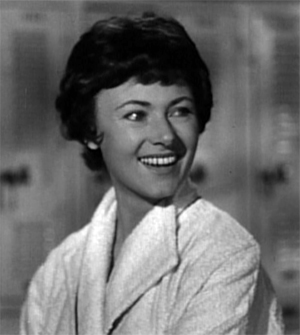
Season 1, Episode 1, "Jeff": Diana Millay (shown on the left, played Laura
Collins on Dark Shadows) plays Blassingame's
childhood girlfriend Jeff. Geoffrey Toone (Steve Gardiner in The Odd Man, Jacques Charlustin on Contract to Kill, Sergeant Baines on 199 Park Lane, and Von Gelb on Freewheelers) plays former boxer Denny
Lipp. Michael Greene (Deputy Vance Porter on The Dakotas) plays abusive drunk Waggoner. Warren Oates (starred in
In the Heat of the Night, The Wild Bunch, and Stripes and played Ves Painter on Stoney Burke) plays a drunk. Marie Selland (wife of director Sam
Peckinpah) plays evangelist Glorie.

Season 1, Episode 2, "School Days": Margaret Field
(mother of actress Sally Field) plays school teacher Eleanor Larson. R.G.
Armstrong (shown on the right, played Police Capt. McAllister on T.H.E.
Cat and Lewis Vendredi on Friday the
13th) plays her admirer Shell Davidson. John Anderson (see the biography
section for the 1960 post on The Life and Legend of Wyatt Earp) plays her killer's brother Leth Ritchie. Richard Rust
(Hank Tabor on Sam Benedict) plays
local lawman Deputy Tyson. William Mims (see the biography section for the 1960
post on The Life and Legend of Wyatt Earp)
plays posse member Ray Huff. Bill Quinn (see the biography section for the 1961
post on The Rifleman) plays posse
member Ted Manning. Dub Taylor (starred in You
Can't Take It With You, Bonnie &
Clyde, and The Wild Bunch, played
Cannonball in 53 western films, and played Wallie Simms on Casey Jones, Mitch Brady on Hazel,
and Ed Hewley on Please Don't Eat the
Daisies) plays posse member Walt Smith.

Season 1, Episode 3, "Brown": John Dehner (shown on the left, played Duke
Williams on The Roaring '20's,
Commodore Cecil Wyntoon on The Baileys of
Balboa, Morgan Starr on The Virginian,
Cyril Bennett on The Doris Day Show,
Dr. Charles Cleveland Claver on The New
Temperatures Rising Show, Barrett Fears on Big Hawaii, Marshal Edge Troy on Young Maverick, Lt. Joseph Broggi on Enos, Hadden Marshall on Bare
Essence, and Billy Joe Erskine on The
Colbys) plays con man Burgundy Smith. Harry Swoger (Harry the bartender on The Big Valley) plays South Fork Sheriff
Tom Lacette. Conlan Carter (C.E. Caruthers on The Law and Mr. Jones and Doc on Combat!) plays his jail keeper Mead. Victor Izay (starred in Dr. Sex, The Astro-Zombies, and Blood
Orgy of the She-Devils and played Judge Simmons on The D.A., Bull on Gunsmoke,
and Dr. Matthew Vance on The Waltons)
plays the bartender.
Season 1, Episode 4, "Mrs. Kennedy": Paul Richards
(appeared in Playgirl and Beneath the Planet of the Apes and
played Louis Kassoff on The Lawless Years)
plays poor dirt farmer Marsh Kennedy.
 Season 1, Episode 5, "Dos
Pinos": Jean Willes (shown on the right, appeared in Invasion
of the Body Snatchers, Ocean's 11,
and Gypsy) plays cantina owner Sal. Adam
Williams (appeared in Flying Leathernecks,
The Big Heat, Fear Strikes Out, and North
by Northwest) plays cattle worker Pauk. Warren Tufts (voiced Captain Fathom
on Captain Fathom, and worked on
animation for Space Angel, Jonny Quest, The New 3 Stooges, Sealab 2020, Challenge of the Superfriends, and Spider-Man and His Amazing Friends)
plays his accomplice Gator. Malcolm Atterbury (starred in I Was a Teenage Werewolf, The Birds, and The Learning Tree and played John Bixby on Wagon Train and Grandfather Aldon on Apple's Way) plays Dos Pinos sheriff Andy. Marie Selland (see
"Jeff" above) plays an injured man's wife Jenny. Marianna Hill
(appeared in Roustabout, Paradise, Hawaiian Style, The Godfather: Part II, and High Plains Drifter and played Rita on The Tall Man) plays saloon girl Cora.
Season 1, Episode 5, "Dos
Pinos": Jean Willes (shown on the right, appeared in Invasion
of the Body Snatchers, Ocean's 11,
and Gypsy) plays cantina owner Sal. Adam
Williams (appeared in Flying Leathernecks,
The Big Heat, Fear Strikes Out, and North
by Northwest) plays cattle worker Pauk. Warren Tufts (voiced Captain Fathom
on Captain Fathom, and worked on
animation for Space Angel, Jonny Quest, The New 3 Stooges, Sealab 2020, Challenge of the Superfriends, and Spider-Man and His Amazing Friends)
plays his accomplice Gator. Malcolm Atterbury (starred in I Was a Teenage Werewolf, The Birds, and The Learning Tree and played John Bixby on Wagon Train and Grandfather Aldon on Apple's Way) plays Dos Pinos sheriff Andy. Marie Selland (see
"Jeff" above) plays an injured man's wife Jenny. Marianna Hill
(appeared in Roustabout, Paradise, Hawaiian Style, The Godfather: Part II, and High Plains Drifter and played Rita on The Tall Man) plays saloon girl Cora.
Season 1, Episode 6, "The Courting of Libby": Joan
O'Brien (shown on the left, starred in Operation Petticoat,
The Alamo, It Happened at the World's Fair,
and It'$ Only Money) plays Blassingame's
love interest Libby Lorraine. John Dehner (see "Brown" above) returns
as Burgundy Smith.
Season 1, Episode 7, "Treasure": Arthur Hunnicutt
(starred in The Red Badge of Courage,
The Last Command, The Cardinal, and Cat Ballou) plays an old prospector. Malcolm Atterbury (see
"Dos Pinos" above) plays Dos Pinos Marshal Frank Dollar.

Season 1, Episode 8, "The Old Man": Sam Jaffe (shown on the right, starred
in Lost Horizon, Gunga Din, The Asphalt Jungle,
and Ben-Hur and played Dr. David
Zorba on Ben Casey) plays dying
patriarch Tyler McKeen. Frank Ferguson (Gus Broeberg on My Friend Flicka, Eli Carson on Peyton
Place, and Dr. Barton Stuart on Petticoat
Junction) plays his son Stuart. Dee Pollock (Billy Urchin on Gunslinger) plays his grandson Billy.
Robert J. Wilke (appeared in Best of the
Badmen, High Noon, The Far Country, and Night Passage and
played Capt. Mendoza on Zorro) plays
covetous relative Murdo McKeen. Michael Forest (starred in Ski Troop Attack, Atlas,
and The Glory Guys and was the voice
of Capt. Dorai on Street Fighter II: V and
Olympus on Power Rangers Lightspeed
Rescue) plays his partner Troy McKeen. Marie Selland (see "Jeff"
above) plays distant relative Addie McKeen.

Season 1, Episode 9, "Ghost of a Chance": Joseph
Wiseman (shown on the left, starred in Detective Story, Viva Zapata!, Les Miserables (1952), Dr. No,
and The Valachi Papers and played
Manny Weisbord on Crime Story) plays Mexican
bandito Serafin. Roberto Contreras (Pedro on The High Chapparal) plays one of his henchmen Pedro. Katy Jurado (appeared
in High Noon, Arrowhead, Trapeze, and One-Eyed Jacks and played Rosa Maria
Rivera on a.k.a. Pablo and Justina on
Te sigo amando) plays bar hostess
Carlotta Jimenez.

Season 1, Episode 10, "Line Camp": Karl Swenson (Lars
Hanson on Little House on the Prairie)
plays camp foreman Ben Potts. Robert Culp (shown on the right, starred in Sunday in New York, Bob &
Carol & Ted & Alice, and Breaking
Point and played Hoby Gilman on Trackdown,
Kelly Robinson on I Spy, Bill Maxwell
on The Greatest American Hero, and
Warren on Everybody Loves Raymond)
plays wrangler Ben Prescott. Slim Pickens (starred in The Story of Will Rogers, Dr.
Strangelove, Blazing Saddles, The Apple Dumpling Gang, Beyond the Poseidon Adventure, and The Howling and played Slim on Outlaws, Slim Walker on The Wide Country, California Joe Milner
on Custer, and Sgt. Beauregard Wiley
on B.J. & the Bear) plays camp
cook Oscar Hudson. Hari Rhodes (Mike Makula on Daktari, D.A. William Washburn on The Bold Ones: The Protectors, and Mayor Dan Stoddard on Most Wanted) plays wrangler Jones. Hank
Patterson (Fred Ziffel on Green Acres
and Petticoat Junction and Hank on Gunsmoke) plays hunter Sample.
Season 1, Episode 11, "Going Home": Virginia Gregg
(starred in Dragnet, Crime in the Streets, Operation Petticoat and was the voice of
Norma Bates in Psycho and was the
voice of Maggie Belle Klaxon on Calvin
and the Colonel) plays wanted outlaw's mother Sabetha. Mary Murphy (appeared
in The Wild One, Beachhead, The Mad Magician,
The Desperate Hours, and Junior Bonner) plays outlaw's wife Suzy.
Jack Kruschen (appeared in The War of the
Worlds, The Apartment, Lover Come Back, and Freebie and the Bean and played Tully on
Hong Kong, Sam Markowitz on Busting Loose, Papa Papadapolis on Webster, and Fred Avery on Material World) plays lawman Rigdon.

Season 1, Episode 12, "Hand on the Gun": Michael
Ansara (shown on the left, appeared in Julius Caesar, The Robe, Voyage to the Bottom of the Sea, and Harum Scarum, played Cochise on Broken
Arrow and Deputy U.S. Marshal Sam Buckhart on The Rifleman and the Law of
the Plainsman, and voiced General Warhawk on Rambo) plays Blassingame's fellow wrangler Oresquote Solera. Ben
Cooper (appeared in Johnny Guitar, The Rose Tattoo, and Support Your Local Gunfighter and played
Waverly on The Misadventures of Sheriff
Lobo and the Director on The Fall Guy)
plays eastern tenderfoot Calvin Davis. John Pickard (Capt. Shank Adams on Boots and Saddles and Sgt. Maj. Murdock
on Gunslinger) plays disgruntled
wrangler Mazo.

Season 1, Episode 13, "The Painting": John Dehner
(see "Brown" above) returns as Burgundy Smith. Madlyn Rhue (shown on the right, played Marjorie
Grant on Bracken's World, Angela
Schwartz on Fame, and Hilary
Mason/Madison on Executive Suite)
plays painting subject Carla de Castiliano. Paul Sorensen (Andy Bradley on Dallas) plays painting seeker Walker.