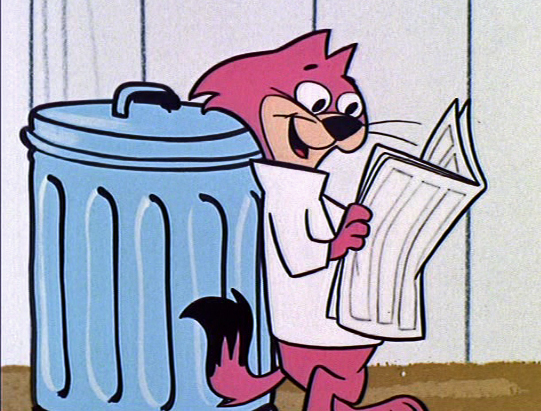
For a series that to this day is considered hugely
influential in the way we envision the future,
The Jetsons has an underwhelming history and is interesting today primarily
for its depiction of devices the creators imagined for the year 2062. The
series was the third attempt by the Hanna-Barbera studio to create a prime-time
animated series, after the success of
The Flintstones in 1960 and the failure of
Top Cat in 1961. Since
The Flintstones
had caught on with its humorous depiction of stone-age versions of mid-century
appliances and other devices, Hanna-Barbera decided to try the same approach in
the opposite direction--the future. So, rather than dinosaurs performing the
tasks that by 1960 were handled electronically,
The Jetsons showed the same functions performed by automation and
robots. As
Matt Novak points out in his 2012
Smithsonian Magazine article "50 Years of The Jetsons: Why the
Show Still Matters," many of the show's futuristic inventions, such as
moving sidewalks, were created elsewhere had already been published in other
forums. Novak says that what
The Jetsons
did was "condense and package those inventions into entertaining 25-minute
blocks for impressionable, media-hungry kids to consume." But the program
wasn't initially intended just for kids, since it was aired in prime-time, and
therein lies the story of why, like
Top Cat, it failed to catch on initially.
Though it was the first prime-time program offered in color
by ABC, as Novak observes, only 3% of American households had color TVs by
1962. Furthermore, since it was the first ABC color program, ABC allowed
individual affiliates to decide whether to broadcast it in color or
black-and-white, and only a handful of larger markets chose the color option,
meaning that very few people saw it in color during its initial run. Novak maintains
that the program loses much of its futuristic appeal when viewed in
black-and-white. On top of this, it was slotted into the Sunday evening
schedule opposite the already-popular
Walt
Disney's Wonderful World of Color
and
Dennis the Menace. Consequently,
the show was canceled after its initial 24 episodes, though ABC continued to
re-run episodes until the new fall schedule began in September 1963. However,
the show was then aired in syndication on Saturday mornings on ABC the
following season and thereafter on Saturday mornings on NBC off and on into the
mid-1980s when it was rebooted for two new seasons. So while its initial run
hardly made a dent on the TV landscape, its long life on Saturday mornings
allowed it to influence an entire generation of impressionable children, with
an increasing number of them having color TVs as the years went by, which helps
to explain how a 1-year flop became an icon of futurism.
As for the content of the show itself, it's a typical
Hanna-Barbera production, meaning that it borrows heavily from worn-out plots
and character types and even its satirical digs at other shows and general
situations are hardly innovative. Whereas Hanna-Barbera had based
The Flintstones characters on those from
Jackie Gleason's
Honeymooners and the
Top Cat characters on those from
The Phil Silvers Show (even casting
Silvers alum
Maurice Gosfield as Benny
the Ball),
The Jetsons is not clearly
based on a particular family sit-com, other than the character of Rosey the
Robot, who has been compared to the title character from
Hazel in that she is an older model with a Brooklyn accent. In a
case of serendipitous coincidence,
Shirley Booth's Hazel has a nightmare in
which she is replaced by Robby the Robot (from
Forbidden Planet fame) in the second episode from Season 2 of
Hazel, which aired on September 27,
1962, just four days after the first episode of
The Jetsons, which introduced the character of Rosey.
The second episode of
The
Jetsons, "A Date With Jet Screamer" (September 30, 1962) pokes
fun at rock 'n' roll teen idols (a la
Ricky Nelson of
The Adventures of Ozzie and Harriet) and their fans when Judy
Jetson enters a song-writing contest and wins a date with the titular Jet
Screamer. Her father George tries to foil her chances of winning by
intercepting her own song submission and replacing it with a language Elroy
developed for talking to his friends in code made up of nonsense words like
"Oop" and "Eek." The big joke is that the nonsensical song
wins the contest, a clear jab at rock 'n' roll songs like
Gene Vincent's
"Be Bop a Lula," which already had been heavily parodied by this
time. And other sit-coms, like
The Dick
Van Dyke Show,
The Donna Reed Show,
and especially
The Many Loves of Dobie Gillis had already covered the territory of lingo-laden pop stars, to say
nothing of the Edd "Kookie" Byrnes character from
77 Sunset Strip.
"Las Venus" (December 16, 1962) recycles the
worn-out joke of a man trying to keep two dates with two different women at the
same time, a gag used heavily in comedy feature films for decades. In this
case, George has promised to take Jane to Las Venus for a second honeymoon at
the same time that his boss Mr. Spacely has ordered him to meet and close the
deal for a lucrative contract with female executive and
Marlene Dietrich
sound-a-like G.G. Galaxy. George has to zip back and forth between two hotels
dancing with each of the women and putting them in an extended dance spin so
that he can dash back to the other hotel and resume his date with the other. Of
course, he can keep up the ruse only so long before Jane discovers he has been
spending time with another woman. Naturally, Ms. Galaxy assures Jane that
George has been all business with her, and she is willing to sign the contract
with Spacely nonetheless so that we get the expected and inevitable happy
ending. A similar type of plot is featured in "Jetson's Nite Out"
(October 7, 1962), only this time George is joined by his boss Cosmo Spacely in
tricking their wives so that they can attend a football playoff game. Spacely
tells his wife that he cannot attend a concert for which she has tickets
because he has to tend to his gravely ill employee Jetson, while George tells
Jane he can't attend the PTA meeting with her because he has to work late.
Eventually they are both found out because the game is televised, and George
has the winning ticket for the stadium's one millionth customer, meaning he
winds up on screen where he is seen by Jane and Mrs. Spacely. If this feels
like a story you have seen elsewhere, either on another sit-com or in the
movies, it's because it is.

Not only did
The
Jetsons borrow liberally from other sources for their stories--they also
borrowed from themselves, regurgitating the same story twice within the first
15 episodes. In "The Flying Suit" (November 4, 1962), Spacely's chief
rival Cogswell's Cosmic Cogs develops a flying suit that can be controlled and
navigated by the wearer's brain waves. George winds up getting the suit through
a mix-up at the cleaners, and Spacely believes that George has invented a way
to enable human flight, while George believes his newfound ability comes from
an invention by Elroy, who coincidentally has been trying to invent a pill to enable
humans to fly. Meanwhile Cogswell's test pilot Harlan returns from the cleaners
with George's ordinary suit which obviously does not fly, and the planned
demonstration of Cogswell's new invention in front of his board of directors is
a disaster. When Spacely then tries to demonstrate what he believes are Elroy's
flying pills to his board of directors, he also falls flat, literally. No one
realizes that the real flying suit still works, and when the clerk from the
cleaners returns the two mixed-up suits to their rightful owners, Cogswell
tells Harlan to simply throw the real flying suit away. About a month later, we
get "Astro's Top Secret" (December 9, 1962) in which the Jetson's dog
Astro swallows Elroy's toy remote-controlled spaceship and is thereby able to
fly, though he is navigated by the toy remote control. After Spacely and
Cogswell have a contentious game of golf, which ends with Spacely threatening
to drive Cogswell out of business, Cogswell assigns Harlan to spy on Jetson to
see if there is any real threat behind Spacely's bluster. When Harlan sees
Astro flying around the Jetson's apartment and reports back to Cogswell, the
latter has Harlan kidnap Astro to try to discover his secret. Naturally, his
efforts to get Astro to reveal his secret are for naught, and Cogswell phones
Spacely to surrender in their business war, much to Spacely's surprise. Astro
is navigated back home by George with the remote-control device. When Spacely
and Cogswell then convene at George's apartment to witness his ground-breaking
invention, George turns off the remote, causing Astro to fall to the ground,
dislodging the toy spaceship to reveal that there was no great invention after
all. The particulars may be a little different, but these two episodes are essentially
the same story, aired 5 weeks apart.

Besides repeating the same story in such a short span of
time, the show seemed to be made up anew each week without much thought given
to consistency from one episode to the next. There are several early episodes
featuring automated food-dispensing systems, but they appear different each
time. In the debut episode "Rosey the Robot" (September 23, 1962) a
fair amount
of time is devoted to the
"food-a-rac-a-cycle," which dispenses fully cooked meals at the touch
of a button, only the Jetson's model is not working properly, and George
complains about having to replace it before he has even paid off the old one.
But by the next episode, "A Date With Jet Screamer"," they have
a different-looking model that Jane programs with computer punch cards. By the
15th episode, "Test Pilot" (December 30, 1962), Jane is making
breakfast with yet another model that has a telephone-like rotary dial and
spits out an entire meal in the form of a pill. If we accept the premise from
the first episode that these appliances are expensive enough to require
long-term financing, it seems impossible that they would be on their third
different model in the span of three months. Likewise, George and Jane's
bedroom accommodations seem to change from one week to the next--sometimes they
have separate beds, sometimes they sleep together in the same bed, and in the
first episode we see only George in a single bed that transforms into a
toaster-like device that pops him out when he won't wake up. Similarly, after much
is made in the first episode of Jane wanting to buy a robot maid to relieve her
of the strain of pushing buttons to clean the house and operating the food-a-rac-a-cycle,
she is back to doing her own housework in the next episode. In fact, Rosey
appears in only two of the first 15 episodes. In short, the creators of
The Jetsons seem not to have had a
clearly defined vision of the details of future life before embarking on their
journey (or felt the need for a continuity supervisor); they simply made it up
as they went along.
And yet despite its rehashing of old stories and lack of detailed
continuity, the one prescient prediction about the future on
The Jetsons is its depiction of how
labor-saving devices would make people lazier, growing more reliant on having
work done for them and therefore becoming less willing to do anything for
themselves. In the opening episode, we see Jane doing a TV workout program that
consists of only exercising her index finger to make it strong enough to push
buttons all day. In another episode George's morning exercises consist of
watching a video of him running and performing other exercises. Though his work
week has shrunk to just three days, George is constantly going to Spacely to
get the afternoon off or a vacation approved. Jane likewise is overcome by
having to push a few buttons to perform housework, so she feels the need to get
a robot maid. But otherwise the characters all act just like other sit-com
characters of the early 1960s: George aspires to career advancement and is
constantly being promoted to Vice President, then fired, then rehired back to
his old job (similar to his being sucked around the treadmill in the closing
credits); Jane loves to shop and spend money and drives dangerously; Judy has a
new boyfriend every week and is obsessed with teen idol singers; and Elroy is
preoccupied with TV super heroes ("Elroy's Pal" [December 23, 1962]),
trying to invent things, including his secret coded language ("A Date With
Jet Screamer"), and playing with his dog. In other words, the underlying
theme from
The Jetsons seems to be
that despite all the technological innovations that could appear a century into
the future, humans will still be the same. Depending on your current view of
humanity, that sentiment is either reassuring or severely depressing.
The theme song and scores for individual episodes of
The Jetsons were composed by
Hoyt Curtin, who was profiled
in the 1961 post on
Top Cat.
The complete series has been released on DVD by Warner Home
Video.
The Actors
For the biography of Daws Butler, see the biography section
in the 1960 post for Rocky and His
Friends. For the biographies of Mel Blanc and Jean Van Der Pyl, see the
biography section in the 1960 post for The Flintstones. For the biography of Don Messick, see the biography section in
the 1961 post for The Flintstones.
George O'Hanlon
George O'Hanlon was born in Coney Island, New York on
November 23, 1912, 15 years after his cousin
Virginia became a cultural icon
for writing a letter to a newspaper asking if there really was a Santa Claus,
prompting the editorial response "Yes, Virginia, There Is a Santa
Claus." The O'Hanlon family had a long history in the entertainment
business dating back to his grandmother performing as a dance hall girl at the
Birdcage Theatre in Tombstone, Arizona during the days of Wyatt Earp and Doc
Holliday. O'Hanlon's parents were also both entertainers: his mother
Lulu
Beeson was a dancer in the burlesque theater circuit, and his father
George,
whose stage name was
Sam Rice, owned a theater in Providence, Rhode Island
where he also produced and directed. Consequently young George grew up around
the theater and became a vaudeville performer himself at a young age while also
being mentored by
Lou Costello of Abbott & Costello fame. The family lost
the theater during the Great Depression and headed out to Hollywood, where
young George began to find work as an extra in movie productions, including
working as a chorus boy in various
Busby Berkeley films. Thanks to a helpful
casting director at Warner Brothers he won a scholarship to the prestigious
Bliss Haydens drama school. Finally in 1942 he got his big break when he was
hired by director
Richard L. Bare to play the everyday average Joe McDoakes in
a short titled
So You Want to Give Up
Smoking. Based on this performance, he was signed to a contract by Warner
Brothers, but after acting in one more McDoakes short, he was drafted into the
Army and served three years during World War II. After the War, O'Hanlon
returned to Warner Brothers, which would produce 61 more McDoakes shorts through
1956 with O'Hanlon now co-writing the scripts with Bare, thereby launching a
long and prolific career as a writer. At the same time, O'Hanlon continued
getting bit parts, sometimes uncredited, in feature films such as
The Spirit of West Point,
Heading for Heaven,
Are You With It?,
The
Counterfeiters, and
June Bride. In
November 1948, O'Hanlon spun off the Joe McDoakes character on his own radio
show,
The George O'Hanlon Show, with
Willard Waterman playing his boss. By the early 1950s he began to find
infrequent guest spots on TV programs such as
My Little Margie,
The Dennis
Day Show, and
The Loretta Young Show.
In 1954 he began appearing as neighbor Calvin Dudley on the
William Bendix
sit-com
The Life of Riley, a series
for which he also wrote a screenplay to dip his foot into the TV screenplay
business. He simultaneously appeared on other programs as a guest star, such as
I Love Lucy,
Sugarfoot,
Maverick,
How to Marry a Millionaire, and
The Red Skelton Hour as well as the
occasional B-movie, such as
Kronos
and
Bop Girl Goes Calypso. But when
he and Bare then tried to adapt the McDoakes character for television and
produced a pilot in the hopes of landing a series, O'Hanlon was fired from
The Life of Riley for moonlighting. In
1959 he tried his hand at not only co-writing the script but also directing the
feature film
The Rookie, starring
Tommy Noonan (who was his co-writer on the script),
Peter Marshall, and
Julie
Newmar. Though he long thought he was not suited for work as a voice actor, he
auditioned for the part of Fred Flintstone with Hanna-Barbera but lost out to
Alan Reed (one account says that he was going to be cast for the role until an
influential sponsor insisted he wasn't right for the part, which led to Reed
being cast). He found more work writing scripts for other series such as
77 Sunset Strip,
The Ann Sothern Show, and
The
Gallant Men before Hanna-Barbera came back to him to have him audition for
the part of George Jetson.
Though
The Jetsons
would make O'Hanlon a TV icon, the original series lasted only 24 episodes, and
he was again looking for work, acting in series such as
The Roaring '20s,
Mister Ed,
and
The Lieutenant while also
co-writing the screenplay for the feature film
For Those Who Think Young with his brother
James and
Dan Beaumont.
In 1964 he was cast in a supporting role as cab driver Artie Burns on
The Reporter starring
Harry Guardino,
but the series lasted only a single season. In the latter 1960s he wrote for
Petticoat Junction,
Gilligan's Island,
Love,
American Style and a couple of different Jackie Gleason series while also
appearing in some of the same episodes as well as on
Marcus Welby, M.D.,
The Name
of the Game, and
Mr. Deeds Goes to
Town. In the early 1970s he had minor roles in the Walt Disney feature
films
The Million Dollar Duck,
Now You See Him, Now You Don't, and
Charley and the Angel as well as
appearing on TV programs such as
Adam-12,
The Partridge Family,
The Odd Couple, and
Mission: Impossible. Then in 1976 he suffered a stroke while
undergoing bypass surgery, which left him nearly blind with compromised short-term
memory. It appeared that he would never work again, and his wife
Nancy
supported the family as a cosmetics company executive. Relegated to watching TV
and sitting around the Motion Picture Hospital, O'Hanlon became obsessed with
bringing back
The Jetsons, with Nancy
later saying he claimed to have a premonition that it would be revived even
though no one was talking about it at the time. Finally in the mid-1980s
O'Hanlon's dream came true, and Hanna-Barbera called him to see if he would
again play the part, even though it meant making substantial accommodations for
him due to his vision and memory impairments. Someone would have to read his
part to him line by line and have him repeat it back on tape. The process was
laborious and exhausting for O'Hanlon, but he finally felt that he was doing
something worthwhile. Hanna-Barbera produced two new seasons of the series in
1985-87 and then decided to do a feature film as well. But while recording his
lines for the film, O'Hanlon was obviously in physical distress.
Joe Barbera had
him rushed to St. Joseph's hospital, where the doctor who examined him said he
had only hours left to live. He passed away on February 11, 1989 at the age of
76.
Penny Singleton
Born
Mariana Dorothy Agnes Letitia McNulty on September 15,
1908 in Philadelphia, her father Benny was a newspaper man there. She began her
entertainment career as a child singing in silent movie theaters and joined the
troupe The Kiddie Kabaret after completing the sixth grade, her last year of
schooling, which she would later regret. After briefly attending Columbia
University, she made her Broadway debut at age 17 in the production
Sky High, billed as
Dorothy McNulty, in
1925. She followed that with
Sweetheart
Time in early 1926 and then
Jack Benny's
The Great Temptations later that same year. Her performance in the
1927-29 production of
Good News as a
replacement for the character of Flo was her ticket to Hollywood as she
reprised the role in the 1930 feature film version. But it took a while for her
movie career to take off. After appearing in another 1930 feature,
Love in the Rough, she returned to
Broadway for the 1932 production
Hey
Nonny Nonny! Other than appearing in
a 1934 short, she did not return to films until 1936 in
After the Thin Man playing the part of Polly. But she felt that the
role typecast her and turned down other similar roles, which somewhat stifled
her career. After appearing in two 1937 films--
Vogues of 1938 and
Sea
Racketeers--she married dentist
Laurence Scroggs Singleton. Even though the
couple divorced two years later, she took his last name as part of a new stage
name, along with the name Penny because as a girl she had collected pennies for
good luck, first using the name for literary pieces she published in national
magazines. The new name appeared to bring her instant good luck because in 1938
she appeared in no less than 11 feature films, including the role that would
change her life, Blondie Bumstead in the first of 28 features in the Blondie
series. If she had felt typecast before, she surely must have felt it now, as
she played little else but Blondie for the next dozen years, the exceptions
being the 1941 comedy
Go West, Young Lady
with
Glenn Ford and
Ann Miller and
Young
Widow in 1946, starring Jane Russell. At the same time, she was playing
Blondie on the weekly radio program from 1939-50. And to cement her place in
the Blondie universe, she even remarried to the film series producer
Robert
Sparks in 1941. But all of that changed when the series was finally retired in
1950. Anticipating the inevitable, she had devised the practice of paying
actors residuals for repeat performances of their work and had a residuals
clause written into her contract for the later Blondie films. Initially she had
her own radio show on the NBC network,
The
Penny Singleton Show, and she made her television debut in an episode of
Pulitzer Prize Playhouse , but these
would be her last credits for over a decade. Nevertheless, she was determined
to keep working and launched her own touring nightclub show which led to being
included on USO tours during the Korean War. In the late 1950s she became very
active in the American Guild of Variety Artists, first being elected to the
union's board and then named President for 1958-59. She advocated for variety
performers to be treated as employees by the producers who hired them,
requiring that they be paid pensions and have unemployment insurance, but when
she began questioning the inconsistencies she saw in the union's various
reports, she was suspended, making her unable to work as a variety performer
herself. She sued the union, and after
Senator John J. McClellan began
investigating unions practices, Singleton was called to testify at
Congressional hearings and eventually won her lawsuit, gaining union
reinstatement and $15,000 compensation in 1963. In the meantime, she was hired
to voice Jane Jetson by Joe Barbera, who was thrilled to be able to use the
iconic voice of Blondie for his space-age sit-com.
Though
The Jetsons
ran for only a single season of 24 episodes, the exposure resurrected
Singleton's acting career, if only briefly. She was cast in an episode of
Death Valley Days in 1963 and one for
The Twilight Zone in 1964. Meanwhile,
her husband Robert Sparks died in 1963. While her return to TV acting fizzled
out quickly, she remained active in her work for AVGA, leading a strike for the
Rockettes dancing troupe in 1967 over working conditions. In 1969 she was
reelected President of AVGA and the next year led a strike by workers of the Disney
on Parade
touring show in which the
producers tried cutting costs by refusing to transport a support stage, thereby
causing the dancers to suffer repeated shin splints because the main stage was
being placed directly on top of concrete and had no give. In the early 1970s
she returned to Broadway as a replacement for the role of Sue Smith in the
1971-73 production of
No, No, Nanette.
Though she only completed sixth grade in her formal education, she received an
Honorary Doctor of Fine Arts Degree from St. John's University in 1974. Her
career was once again revived with the reboot of
The Jetsons in 1985, and though most of her late career was voicing
Jane Jetson in a variety of TV movies, shorts, the 1990 feature film, and the
series itself, it also led to her appearing in a 1986 episode of
Murder, She Wrote. She died at age 95 on
November 12, 2003.
Janet Waldo
Born
Patricia Waldo in Grandview, Washington on February 4,
1919, her mother was a singer who trained at the Boston Conservatory of Music,
and her father,
Benjamin Franklin Waldo (purportedly a distant cousin of
Ralph
Waldo Emerson) was a railroad man whose job required the family to move
frequently. Her elder sister
Elisabeth would become an award-winning violinist
and composer, and while his daughters were still young her father decided he
didn't want them to grow up to marry farmers, so he sold the family farm and moved
the family to Seattle. Janet began her acting career in church plays and got
her first big break while performing in a theatrical production while attending
the University of Washington where alumnus
Bing Crosby was staging a talent
scout promotion. Crosby's scouts encouraged Waldo to enter their contest, which
she won, the prize being a trip to Hollywood with Crosby and a movie contract
with Paramount. However, Waldo recalled in a later interview with
Leonard
Maltin that the studio didn't really know what to do with her and that she
never felt comfortable in front of the camera, so her early film career
consisted largely of bit parts, beginning in 1938 with features such as
Cocoanut Grove with
Fred MacMurray and
Harriet Nelson and
Sing, You Sinners
with Crosby, MacMurray, and
Donald O'Connor. She played a number of hat check
girls, receptionists, , and telephone operators as well as occasionally
credited parts in features such as
Tom
Sawyer, Detective,
Zaza,
Persons in Hiding,
The Star Maker, and
What a
Life. Though she worked her way up to leading roles in a few westerns by
the early 1940s, such as
One Man's Law,
The Bandit Trail, and
Land of the Open Range, her option was
dropped around 1942. Crosby's brother
Larry, producer of the radio program
Kraft Music Hall, took her under his
wing, and she began getting parts on radio with
Lux Radio Theatre in 1941. Waldo says she felt right at home doing
radio theater and would appear on dozens of programs, including occasionally on
Bing Crosby's show. She says her big break came when she auditioned for and was
cast on
Edward G. Robinson's
Big Town.
But her biggest breakout came in 1944, first portraying dizzy teenager Emmy Lou
on
The Adventures of Ozzie and Harriet
(a role she would continue playing when the program transitioned to television
in the 1950s) and taking over the title role on
Meet Corliss Archer from
Priscilla Lyon. She would continue playing
Archer for almost a decade, until 1953, but did not follow the program when it
transitioned to TV. In 1948 she married writer
Robert E. Lee, who with his
partner
Jerome Lawrence would write
Inherit
the Wind,
Auntie Mame, and
First Monday in October, and she would
appear on some of Lee's radio programs such as
Favorite Story, playing opposite
William Conrad in an adaptation of
Wuthering Heights. She also
co-starred with
Jimmy Lydon on the short-lived teen radio series
Young Love from 1949-50. Though she
didn't do much live-action television, she had a memorable debut as star-struck
teenager Peggy Dawson in a 1952 episode of
I
Love Lucy (she had appeared on
Lucille Ball's radio program
My Favorite Husband years earlier). She
appeared 5 times as Emmy Lou in the first TV season of
The Adventures of Ozzie and Harriet in 1953, and would continue to
pop up as a variety of other characters over the show's 14 seasons, including
one named Janet in the series' later years. But Waldo's career had hit
something of a lull in the latter 1950s and early 1960s until she was tabbed to
voice space-age teenager Judy Jetson in 1962.
Like others in
The
Jetsons' cast, Waldo became a regular member of the Hanna-Barbera voice
cast for years afterward. She took over the role of Pearl Slaghoople on
The Flintstones in 1964, voiced Granny
Sweet on
The Atom Ant Show and
Precious Pupp, played Nancy on
Shazzan, voiced Penelope Pitstop on
Wacky Races and
The Perils of Penelope Pitstop, was Jenny Trent on
Around the World in 79 Days and
Cattanooga Cats, voiced Josie on
Josie and the Pussycats and
Josie and the Pussycats in Outer Space,
was Widow Wilson on
The Funky Phantom, played Mrs. Anders on
Jeannie, and was Morticia Addams in the
1973 animated version of
The Addams
Family. And these are just the regular roles she voiced--she also provided
various voices for many other Hanna-Barbera cartoons as well as voicing the
character of Lanna Lang on a number of Superman-related cartoons, including
The New Adventures of Superman,
The Adventures of Superboy, and
The Superman/Aquaman Hour of Adventure.
After the cancelation of
The Jetsons,
she also began to get more guest star work on live-action TV shows, such as
Saints and Sinners,
The Andy Griffith Show, and
The Lucy Show. In 1964-65 she co-starred with
Anthony Franciosa and
Jack Soo on
the sit-com
Valentine's Day playing
the role of Libby Freeman. In the mid- to late-60s she guest starred on
Please Don't Eat the Daisies,
Petticoat Junction,
The F.B.I.,
The New
Adventures of Huckleberry Finn, and
Julia.
From then on, she worked exclusively providing voices for dozens of animated TV
series and TV movies, except for reprising her role as Amanda on the reunion TV
movie
Return to Mayberry in 1986. She
returned as Judy Jetson when the series was rebooted in 1985 but was replaced
for the 1990 feature film by pop star
Tiffany at the direction of executives at
Universal Pictures. The move backfired because loyal
Jetsons fans were outraged, and by the time of the film's release,
Tiffany's 15 minutes of fame had expired. Waldo, meanwhile, continued voicing
various animated characters throughout the 1990s as well as performing in
smaller Los Angeles-area theatrical productions and those of the California
Artists Radio Theatre. In 2011 she was diagnosed with a benign but inoperable
brain tumor and died 5 years later at the age of 97 on June 12, 2016.
Notable Guest Stars
Because it was an animated series, The Jetsons did not have guest stars but occasionally brought in
other voice actors as listed below.
Season 1, Episode 2, "A Date With Jet Screamer":
Howard
Morris (shown on the left, appeared in
Boys' Night Out,
The Nutty Professor, and
High Anxiety, played Ernest T. Bass on
The Andy Griffith Show, and voiced
Beetle Bailey, Gen. Halftrack, Otto, and Rocky on
Beetle Bailey, Breezly Bruin on
The
Peter Potamus Show, Mr. Peebles on
The
Magilla Gorilla Show, Atom Ant on
The
Atom Ant Show, Jughead Jones, Big Moose, and Dilton Doiley on
The Archie Show and
Archie's Funhouse, Frankie, Wolfie, and Dr. Jekyll on
Sabrina and the Groovie Goulies, Cousin
Ambrose on
Sabrina, the Teenage Witch,
and The Hamburglar on
McDonaldland)
plays teen idol Jet Screamer.
Season 1, Episode 6, "The Good Little Scouts":
Dick
Beals (shown on the right, voiced Gumby on
The Adventures of
Gumby and
The Gumby Show, Buzzer
Bell and Shrinking Violet on
The Funny
Company, Yank on
Roger Ramjet,
Davey Hanson on
Davey and Goliath,
Buzz Conroy on
Frankenstein, Jr. and the
Impossibles, Reggie Van Dough on
The
Richie Rich/Scooby Doo Show and
Richie
Rich, Scat on
The Biskitts, and
N.J. Normanmeyer on
The Addams Family)
plays Mr. Spacely's son Arthur.
Season 1, Episode 7, "The Flying Suit": Howard Morris
(see "A Date With Jet Screamer" above) plays Cogswell test pilot
Harlan.
Season 1, Episode 8, "Rosey's Boyrfriend": Howard
Morris (see "A Date With Jet Screamer" above) plays Judy's boyfriend
Booster Pendleton.
Season 1, Episode 11, "A Visit From Grandpa":
Howard
Morris (see "A Date With Jet Screamer" above) plays George's
grandfather Montague Jetson.
Bea Benaderet (shown on the left, see the biography section for the
1960 post on
The Flintstones) plays
stranded motorist Emily Scope and young mother Celeste Skyler.
Season 1, Episode 12, "Astro's Top Secret": Howard
Morris (see "A Date With Jet Screamer" above) returns as Cogswell
assistant Harlan.
Season 1, Episode 14, "Elroy's Pal": Howard Morris
(see "A Date With Jet Screamer" above) plays children's TV star
Nimbus the Great and Elroy's friend Willie.