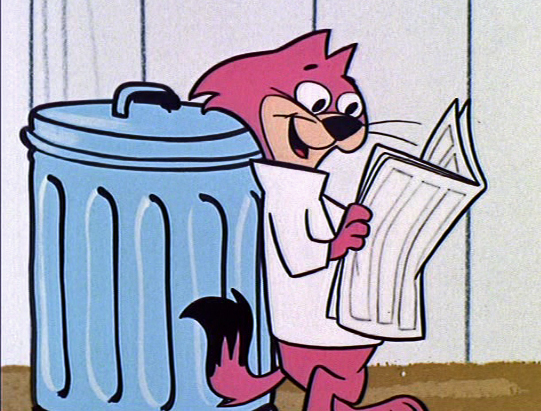
After their success launching their first prime-time
animated series
The Flintstones in
the fall of 1960,
Joseph Barbera and
Bill Hanna came up with a second series
for the fall of 1961 using the same formula--basing it on a beloved live-action
TV sitcom of the 1950s, in this case
You'll
Never Get Rich, later known as
The
Phil Silvers Show. Such was the popularity of
The Flintstones that Barbera years later recalled that he was able
to sell the series using only a sketch of the main character, rather than any
developed stories or supporting characters. But once the series began
development, they cemented the connection to Silvers' show by having veteran
comedian
Arnold Stang do his best
Phil Silvers impression in voicing the title
role. They also hired actor
Maurice Gosfield, who played Pvt. Duane Doberman to
Silvers' Sgt. Bilko, as the voice of Top Cat's sidekick Benny the Ball, and
they hired writers like
Barry Blitzer, who had written 17 scripts for
The Phil Silvers Show. Like Bilko, Top
Cat is a financial schemer always looking for an opportunity to make a quick
buck, though he always plans for the rest of his gang to also benefit if he is
successful. He is always running afoul of beat cop Charlie Dibble, who is
constantly threatening to bust him for not keeping his alley clean, using his
call box phone, or being somehow involved in whatever crime Dibble has been
assigned to solve. But despite their seemingly antagonistic relationship,
Dibble is actually fond of Top Cat and his antics. In the very first episode
"Hawaii Here We Come" (September 27, 1961), Dibble becomes depressed
at the prospect of Top Cat and his crew having drowned when they jump off a
cruise ship after Dibble accuses them of passing counterfeit currency.
Likewise, in "Top Cat Falls in Love" (November 8, 1961), Dibble is
saddened thinking that Top Cat is near death, when in actuality Top Cat has
only faked a rare illness to spend more time with nurse Miss LaRue with whom he
is infatuated.

But while Barbera and others considered
Top Cat to be one of the most sophisticated animated series they
ever produced, it basically used only a handful of story lines recycled over
and over, and the characters always wind up back where they started at the end
of each episode, no better or worse off for all their frantic activity. Just in
the 14 episodes that aired in 1961 alone, there are two stories about Top Cat
failing to realize he has a fortune in his hands and throwing it away. In
"The Maharajah of Pookajee" (October 4, 1961) Top Cat reads about a
famed maharajah coming to town who gives out valuable rubies to people he
likes. So in order to get into the hotel where the maharajah will be staying, Top
Cat and the gang impersonate him and his entourage, even dispensing fake glass
rubies, but after being found out by Dibble, they flee the hotel and Top Cat
runs into the real maharajah and is given a ruby when he helps him up. But
naturally Top Cat thinks this is just another imposter handing out fake glass,
so he tosses it into the bay until he finds out from Dibble that the ruby was
real. By then it is too late, and Top Cat has squandered an opportunity to
achieve the wealth he seeks. Likewise in "The Tycoon" (December 27,
1961) Benny the Ball is given a check made out to Top Cat for a million dollars
by a billionaire who wants to imitate a generous TV character (based on the
real-life TV show
The Millionaire),
but Top Cat refuses to believe the check is real and tears it up into many
pieces that then wind up in the city dump, once again thwarting his dreams of
wealth.

We also get two romance-driven plots that go nowhere. In
"Top Cat Falls in Love" (November 8, 1961) Top Cat becomes infatuated
with a nurse he encounters while visiting Benny in the hospital. As mentioned
above, he fakes a rare disease to get admitted to the hospital, figuring that
he can wear her down and marry her, only to find that she is engaged to a
doctor in another town, leaving Top Cat with a burly replacement nurse that he
then has to trick in order to escape from. In "Choo-Choo's Romance"
(December 6, 1961), Choo-Choo falls for Parisian kitten Goldie living in a
nearby apartment, and Top Cat goes to great lengths to help him romance her,
convinced that once he really gets to know her he won't be so enamored. This
scheme requires Top Cat to fake his own death in a duel with Goldie's boyfriend
Pierre, but when Choo-Choo considers a life without Top Cat and the rest of the
gang, he abandons Goldie and she returns to Pierre. In other words, the bottom
line in Top Cat is that where you are
is the best place you can be--striving for wealth or romance will not bring
happiness.

The same theme is hammered home in "The Missing
Heir" (October 28, 1961) when Top Cat sees an ad in the paper notifying
the heir of a million-dollar estate that he must come forward within 24 hours
or lose the inheritance. Since Benny has a few of the physical characteristics
mentioned in the ad, Top Cat has him pose as the missing heir, but then the
real heir shows up just as the cats expose attempts by the butler and family
dog to do away with Benny and get the inheritance for themselves, meaning that
Top Cat and his gang walk away with nothing because the real heir inherits the
esetate. Even worse, the real heir gives away his fortune and shows up in
Hoagy's Alley wanting to join Top Cat's gang, as if belonging to his gang is
more desirable than being what Top Cat is constantly seeking--to become rich.

One of the characteristics of
The Flintstones that made it such a big hit was its clever
skewering of contemporary pop culture and modern conveniences reimagined in
Stone Age form, thereby confirming the old adage that there's nothing new under
the sun.
Top Cat did not take the
same approach in recasting human foibles in cat-centric terms--instead the cats
wear human clothes, can drive a car, and converse with humans as if they speak
the same language. But the series does take a poke at several popular TV shows
in episodes such as "The Unscratchables" (December 13, 1961), a
painfully obvious jab at the very popular series
The Untouchables replete with mobsters and the cats decked out in
zoot suits. " The Maharajah of Pookajee" has more mobsters, whom Top
Cat first takes for actors from the popular shows
Peter Pistol (i.e.,
Peter Gunn) or
Have Gun -- Will Shoot
(i.e.,
Have Gun -- Will Travel), but
these are merely winks to the viewing audience rather than a developed satire.
However, "Naked Town" (November 18, 1961) offers a more pointed
critique of the TV-obsessed public when Officer Dibble is assigned to keep a
block of streets cleared for the filming of an episode for the show
Naked Town (i.e.,
Naked City) and actually ends up aiding a pair of warehouse thieves
who show up early and pretend to be TV producers. The ever gullible Dibble is
thrown off his guard after Top Cat butters him up when hearing of his choice
assignment, suggesting that it could be the first step to an acting career and
an Academy Award so that when the imposter producers appear, Dibble bends over
backwards to please them, as do Top Cat and the gang, and sees nothing
suspicious when they tell Dibble to wait around the corner while the crooks
empty a warehouse full of new merchandise with Top Cat's help.

However, TV viewing audiences were not star-struck when
Top Cat was originally broadcast. It
failed to crack the top 30 and was canceled after one season, though it did
return in syndication shown during morning children's programming. As
documented below, Hanna-Barbera considered resurrecting the series a few years
later, but after Maurice Gosfield's death, those plans were canceled. The
Top Cat characters would resurface on
later Hanna-Barbera ensemble shows such as
Yogi's
Treasure Hunt and
Yogi's Gang.
And in 1988 they released a TV movie called
Top
Cat and the Beverly Hills Cats with many of the original voice actors
reprising their roles. Though remembered fondly by many today,
Top Cat falls somewhere in the middle of
the pack for cartoons of the era--certainly head and shoulders above what was
coming out of UPI but below Hanna-Barbera's better offerings
The Flintstones and
The Jetsons as well as
Jay Ward's
Bullwinkle Show. One last legacy note--the trademark wheezing laugh
from Dick Dastardly's dog sidekick Muttley was first voiced by Hanna-Barbera
regular
Don Messick while playing the dog Griswold in the episode "The
Missing Heir."

The theme song and scores for individual episodes of Top Cat
were composed by Hanna-Barbera musical director
Hoyt Curtin. Born Hoyt Stoddard
Curtin in Los Angeles in 1922, he grew up in San Bernadino where his father
sold insurance. Curtin started playing piano at age 5 and won a talent contest
with his singing at age 12. In junior high school he led his own combo, and
after serving in the Navy during World War II he enrolled at USC
to study music. His original plan was to
write scores for feature films but after only being offered work on such B-film
fare as
Mesa of Lost Women,
Jail Bait, and
Plan 9 From Outer Space, he instead concentrated on radio and TV
commercials. In 1957 he worked with Hanna-Barbera on a Schlitz beer commercial,
which they remembered after leaving MGM to set up their own studio. When
producing their first cartoon series
The
Ruff and Ready Show, they called
Curtin with a lyric and asked him to write a score for it, which he was able to
do in about 5 minutes. Thereafter he became their sole musical composer and
director, writing themes to their iconic cartoon series
Huckleberry Hound,
Quick Draw
McGraw,
The Flintstones,
The Jetsons, and
Jonny Quest, to name but a few. He continued working for
Hanna-Barbera until 1989, his last credit being for
The Smurfs, and finally retired from composing in 1992. He passed
away December 3, 2000 at age 78. Since Curtin tended to use the same musicians
from one series to the next, the vocal group singing the theme to
Top Cat is very likely the
Randy Van
Horne Singers, the group Curtin used when lyrics were added to
The Flintstones theme in Season 3.
The Actors
For the biography of
John Stephenson, see the 1961 post for
The Flintstones.
Arnold Stang

Although he claimed to be from Chelsea, Massachusetts, Stang
was born in New York City on September 28, 1918. But by age 9 he was living in
Chelsea when he sent a postcard to a New York radio station requesting an
audition. When the audition was granted, Stang secretly took a bus without his
parents' knowledge to Manhattan and wound up being offered a job, which he then
had to reveal to his parents after returning home. It was the beginning of a
long and prolific career in radio, film, and television in which Stang would
play a host of Brooklyn-accented wiseguys, except for his role on
Top Cat for which he was required to
mimic Phil Silvers of
Sgt. Bilko fame.
But long before that as a child voice actor he appeared on children's radio
programs such as
Let's Pretend,
The Horn and Hardhart Children's Show,
and
American Pageant of Youth before
moving on to all-age comedies like
The
Goldbergs and crime dramas like
Gangbusters.
In the 1940s he decide to try his hand in Hollywood, where he had bit parts in
films such as
My Sister Eileen,
Seven Days' Leave, and
Let's Go Steady. He eventually decided
to return to New York and to radio, landing regular work first on
The Al Jolson Show and by 1947 on
The Milton Berle Show. Stang also found
voicework for Paramount cartoons, providing the voice for the mouse Herman in a
series of Herman and Katnip shorts, and also ventured into early New York-based
television on shows such as
Laughter in
Paris and
The Henry Morgan Show,
but he would not join
Berle's TV show
until 1953. His exposure on Berle's show led to a flood of offers,
including joining the TV version of
The
Goldbergs and landing a prime dramatic role in the feature
The Man With the Golden Arm. He also had
a few TV guest spots on shows such as
December
Bride and
The Red Skelton Hour
before returning to Hollywood in the early 1960s, which led to spots on
Wagon Train and
Bonanza as well as being recruited for the title voice role on
Top Cat.

Top Cat would not
be his last regular TV role. After appearing in large ensemble features
The Wonderful World of the Brothers Grimm
and
It's a Mad Mad Mad Mad World,
Stang was cast as Stanley Stubbs in the short-lived female Navy comedy
Broadside in 1965, the same year he
appeared in the country exploitation feature
Second Fiddle to a Steel Guitar and provided the voice of Nurtle
the Turtle in the animated
Pinocchio in
Outer Space. In the late 1960s he was a regular performer on
The Jonathan Winters Show and appeared
in the campy LSD feature
Skidoo as
well as the underwater adventure
Hello
Down There. In 1970 he starred opposite
Arnold Schwarzenegger in the
bodybuilder's first feature film
Hercules
in New York and spent the rest of the decade doing occasional voicework and
TV guest spots on
Emergency!,
Chico and the Man, and
Flying High. He reprised the voice of
Top Cat for the 1980s animated series
Yogi's
Treasure Hunt and had his final credits doing a variety of voices for the
1999-2002 animated series
Courage the
Cowardly Dog. In his later years he and his wife moved to Greenwich,
Connecticut and then Needham, Massachusetts. He died from pneumonia in Newton,
MA on December 20, 2009 at the age of 91. For a more detailed biography, see
WFMU's Beware of the Blog.
Maurice Gosfield

Born in New York City, Maurice Lionel Gosfield grew up in
Philadelphia and Evanston, Illinois where he attended high school and first got
involved in community theater. In 1934 he was acting in the Ralph Bellamy and
Melvyn Douglas Players in Chicago doing Shakespeare before moving to New York
and making his Broadway debut in Siege
in 1937. During World War II he served in the army as a Technical Sergeant,
then returned to the theater after the war ended. He made his TV debut in a
1949 episode of The Clock and had an
uncredited part in the feature Ma and Pa
Kettle Go to Town the following year. But his big break came when he was
cast in the Sgt. Bilko pilot The New
Recruits in 1955. Writer Nat Hiken recalled in his autobiography that
Gosfield showed up at an open casting call with a lengthy list of credits that
included not only his handful of theatrical roles but a claim of over 2000
radio appearances and hundreds of TV roles, which Hiken said were impossible to
verify. Some of those radio appearances were on a show with Phil Silvers that
lasted only a couple of months. Nevertheless, Hiken felt that Gosfield's short
portly appearance was perfect for the role of dimwitted Pvt. Duane Doberman
(though he was named Pvt. Mulrooney in the pilot) on The Phil Silvers Show. Gosfield's role as Doberman made him a
household name, earning him TV's Bachelor of the Year Award in 1957 and an Emmy
nomination in 1959. DC Comics even created a series of comic books titled Sgt. Bilko's Pvt. Doberman. But after
the show's demise, Gosfield only managed a few TV guest spots on programs such
as The Detectives, The Jim Backus Show, One Happy Family, and The Red Skelton Hour before being tabbed
to voice Benny the Ball in the Sgt. Bilko-inspired Top Cat in 1961.

Gosfield said that he enjoyed voicing Benny the Ball as much
or more than playing Pvt. Doberman because he felt it was more prestigious
playing a cat as opposed to someone named after a dog. But after Top Cat's cancellation, he had only one
more film role, a cameo as a garbage collector in the Doris Day & James
Garner comedy The Thrill of It All in
1963. In 1964 he auditioned for the part of Uncle Fester on The Addams Family but lost out to Jackie
Coogan. On October 14, 1964 he became ill while performing at New York Theatre
and after being sent to a couple of different hospitals and being prescribed a
host of medicines, he suffered a heart attack three days later. He was again
rushed to the hospital and survived two more days, during which time he was
visited by Arnold Stang, who told him that Hanna-Barbera was planning to revive
Top Cat. But two hours after Stang
left, Gosfield suffered another heart attack and died at age 51 on October 19,
1964.
Leo de Lyon

Born Irving Levin in Paterson, New Jersey on April 27, 1926,
de Lyon got his first big break when he won a competition as a piano-playing
comedian on Arthur Godfrey's Talent Scouts
in 1947, which led to him getting booked into small theaters around New York.
Eventually he worked his way up to larger venues, such as Harold Minsky's
Carnival in Manhattan, where he became friends with singer Ralph Young, later
of the musical duo Sandler & Young. De Lyon wrote the duo's first ten
arrangements and would be recruited decades later to be their music director in
the 1970s. After a stint at the Olympia in Miami, he returned to New York to
play the Strand Theater. When Josephine Baker returned to America for a
triumphant engagement in 1951, de Lyon performed between her sets for 8 months.
In 1952 he scored his first regular television role on the sitcom It's a Business, but the show was
short-lived and afterward he returned to the nightclub circuit, including
traveling to London to play the Palladium with the Platters and Lonnie Donegan
in 1956. He returned to TV when he was cast as Spook and Brain on Top Cat in 1961.

After
Top Cat was
canceled, de Lyon continued his comedy routine but started finding occasional
TV guest spots in 1964. After appearing on
The
New Phil Silvers Show that year, he and Silvers worked up a musical comedy
act that opened at the Cork Club in Houston and then moved on to the Sahara in
Las Vegas. The duo continued the act for roughly four years. Meanwhile de Lyon
logged guest appearances on
The Jack Benny Program,
My Mother the Car,
and
Bewitched. In 1967 he voiced
Flunkey in the Disney animated feature
The
Jungle Book. He released a novelty 45 rpm record sometime in the 1960s
billed as Leo de Lyon and the Musclemen, who included a young
Al Kooper. He had
a memorable guest appearance accompanying
Dean Martin on a 1970 episode of
The Dean Martin Show. He returned to
cartoon voicework in the 1980s for Hanna-Barbera on
Paw Paws in 1985-86 and
Foofur
in 1987. And he reprised the voices of Spook and Brain for the 1988 TV movie
Top Cat and the Beverly Hills Cats. He retired
from performing in 2011 but is still living.
Marvin Kaplan

Marvin Wilbur Kaplan
was born in Brooklyn in 1927, the son of a doctor. After graduating from
Brooklyn College with an English degree in 1947, he enrolled at USC in the
Master's program for radio playwriting. The head of the department was
Cecil B.
DeMille's older brother
William C. DeMille, who, after reading one of Kaplan's
one-act plays, advised the aspiring writer to take a job as a stage manager to
see firsthand what actors do to writers' lines. Because he did not own a car,
Kaplan's options were limited and he wound up at the Circle Theater in Los
Angeles, getting the job when they mistook him for somebody else. Several of
the plays at the theater were directed by
Charlie Chaplin, who refused to be
credited because his sons performed there and he didn't want his involvement to
negatively reflect on them. Kaplan eventually worked his way into acting in the
theater's productions and one night during a performance of a
Moliere comedy
Katherine Hepburn was in the audience and came backstage afterward to
compliment Kaplan on his work. He credits her feedback in making the decision
to pursue an acting career. The next day there was a note on the theater
bulletin board for him to call MGM, where he was given an appointment with
director
George Cukor. Cukor told him that Hepburn was acting as his agent and
recommended that he be cast in her latest picture
Adam's Rib in which Kaplan wound up playing the court stenographer
who famously asks the correct spelling of "Pinky," Hepburn's
character's nickname. From there he would appear in a string of features such
as
Francis,
The Reformer and the Redhead, and
Angels in the Outfield. He moved into radio when he was cast as
Alfred Prinzmetal in the sitcom
Meet
Millie and was retained in the same role when the series moved to
television in 1952. In the late 1950s he appeared on
Make Room for Daddy and
The
Red Skelton Hour, then began the 1960s appearing in the Ernie Kovacs comedy
feature
Wake Me When It's Over and
guest starring on
M Squad,
The Many Loves of Dobie Gillis, and
The Detectives before being cast as the
voice of Choo-Choo on
Top Cat.

After
Top Cat his
work in feature films outshone his television appearances. Though he appeared
in
Jerry Lewis'
The Nutty Professor,
he later said in an interview that Lewis cut out many of his scenes and was
mean to him. But he had a memorable scene with
Top Cat alumnus Arnold Stang in
It's
a Mad Mad Mad Mad World. He also appeared in
Blake Edwards' comedy
The Great Race. Meanwhile he was logging
more TV guest spots on shows such as
McHale's
Navy,
Honey West,
Gomer Pyle USMC, and
My Three Sons. He also returned to his
original vocation as a script writer, penning episodes of
The Addams Family,
The Bill
Cosby Show,
Mod Squad, and
Maude. In 1971 he had a recurring role
on the comedy
The Chicago Teddy Bears,
which starred
Dean Jones and
John Banner. His credits in the 1970s were sparse
until he was cast as telephone repairman and regular diner customer Henry on
Alice, appearing 82 times between 1978
and 1985. In 1984 he joined the California Artists Radio Theatre and served on
its board for 32 years. He also served as President of the Los Angeles chapter
of the American Federation of Television and Radio Artists for 8 years. More
occasional work followed in the 1980s, including reprising the voice of
Choo-Choo in
Top Cat and the Beverly
Hills Cats. In 1990 he appeared in the
David Lynch film
Wild at Heart and then was cast as
Dwight McGonigle in the TV series
On the
Air which Lynch had started but left after becoming bored, leading to the
show's cancellation after 7 episodes. He appeared as Mr. Gordon in 4 episodes
of the
Ted Danson series
Becker and
provided various voices for
The Garfield
Show between 2008 and 2013. He died of natural causes at age 89 on August
25, 2016.
Allen Jenkins

Born Alfred McGonegal on Staten Island in 1900, Jenkins was
the son of two musical theater performers, Robert and Leona Jenkins. During
World War I he helped build ships at the Brooklyn Navy Yard and later found
work in the theater as a stage mechanic. He then attended the American Academy
of Dramatic Arts and made his theatrical debut in a production of Checkers. Soon thereafter he would dance
in a chorus with up-and-comer James Cagney in Pitter Patter. He would go on to appear in productions of Rain, What Price Glory?, The Front
Page, Five Star Final, and Blessed Event. After taking over the
role vacated by Spencer Tracy in a Broadway production of The Last Mile, he was summoned to Hollywood by Darryl F. Zanuck and
originally signed to Paramount Pictures before moving over to Warner Brothers.
His first film appearance came in the 1931 short Straight and Narrow, the first of some 175 film credits in which he
often played comic heavies, from gangsters to policemen, including the film
version of Blessed Event in 1932, I Am a Fugitive From a Chain Gang, 42nd Street, A Night at the Ritz, Destry
Rides Again, Tin Pan Alley, Dive Bomber, Ball of Fire, and The Inside
Story. He broke into television in 1952, appearing on shows such as Racket Squad, The Life of Riley, and I Love
Lucy. His first recurring role was playing Johnny on The Duke in 1954, followed by 5 appearances as Alfie Malone on Damon Runyan Theater in 1955-56. Over
the years he appeared as the character Muggsy on 11 episodes of The Red Skelton Hour between 1954-62. He played cab driver Al
Murray on 26 episodes of the Jeannie Carson sitcom Hey, Jeannie! in 1956-57 and had a supporting role as an elevator
operator in the Doris Day-Rock Hudson feature Pillow Talk in 1959 before being cast as Officer Dibble on Top Cat 2 years later.

Following
Top Cat
he found steady work doing guest spots on TV show such as
The Real McCoys,
The Man From U.N.C.L.E.,
Batman, and
Bewitched. He also had supporting roles in feature films such as
It's a Mad Mad Mad Mad World,
Robin and the 7 Hoods, and
For Those Who Think Young. Later in life
he publicly admitted to being an alcoholic and reportedly was the first actor
to testify about his condition before the U.S. Congress. After contracting lung
cancer, he died from complications due to surgery on July 20, 1974 at the age
of 74. His last screen credit was in
Billy Wilder's feature film version of the
play he had appeared in decades before--
The
Front Page--which was released after his death.
Notable Guest Stars
Because it was an animated series, Top Cat did not have many guest stars known from other shows,
except those listed below.
Season 1, Episode 1, "Hawaii Here We Come":
Don
Messick (see the biography section for the 1961 post on
The Flintstones) plays a thief disguised as an old lady.
Season 1, Episode 3, "All That Jazz":
Daws Butler
(shown on the left, see the biography section for the 1960 post on
Rocky and His Friends) plays new cat in town Jazz.
Don Messick (see
"Hawaii Here We Come" above) plays his sidekick Beau.
Season 1, Episode 4, "The $1,000,000 Derby":
Hal
Smith (see the biography section for the 1961 post on
The Andy Griffith Show) plays a racetrack announcer.
Season 1, Episode 6, "The Missing Heir": Don
Messick (see "Hawaii Here We Come" above) plays the dog Griswold.
Season 1, Episode 7, "Top Cat Falls in Love":
GeGe
Pearson (shown on the right, voiced Crusader Rabbit on
Crusader
Rabbit) plays nurse Miss LaRue.
Don Messick (see "Hawaii Here We
Come" above) plays physician Dr. Dawson.
Jean Vander Pyl (see the
biography section for the 1960 post on
The Flintstones) plays a beefy nurse.
Season 1, Episode 8, "A Visit From Mother":
Bea
Benaderet (see the biography section for the 1960 post on
The Flintstones) plays Benny the Ball's mother.
Season 1, Episode 11, "Choo-Choo's Romance": Jean
Vander Pyl (see "Top Cat Falls in Love" above) plays Parisian cat
Goldie.
Season 1, Episode 12, "The Unscratchables":
Herschel Bernardi (shown on the left, see the biography section for the 1960 post on
Peter Gunn) plays gangster Muggsy.
Bea
Benaderet (see "A Visit From Mother" above) plays gangster moll Fifi.
Season 1, Episode 13, "Rafeefleas": Bea Benaderet
(see "A Visit From Mother" above) plays Fancy-Fancy's girlfriend
Shirley. Jean Vander Pyl (see "Top Cat Falls in Love" above) plays
another unnamed Fancy-Fancy girlfriend.
Season 1, Episode 14, "The Tycoon": Don Messick
(see "Hawaii Here We Come" above) plays billionaire T.L.
Vanderfeller. Bea Benaderet (see "A Visit From Mother" above) plays
haberdasher's wife Mildred.